
exhibition
All ProgrammeInfo~Angel: The Spanish Civil War
When Aalst showed solidarity with its Spanish counterparts

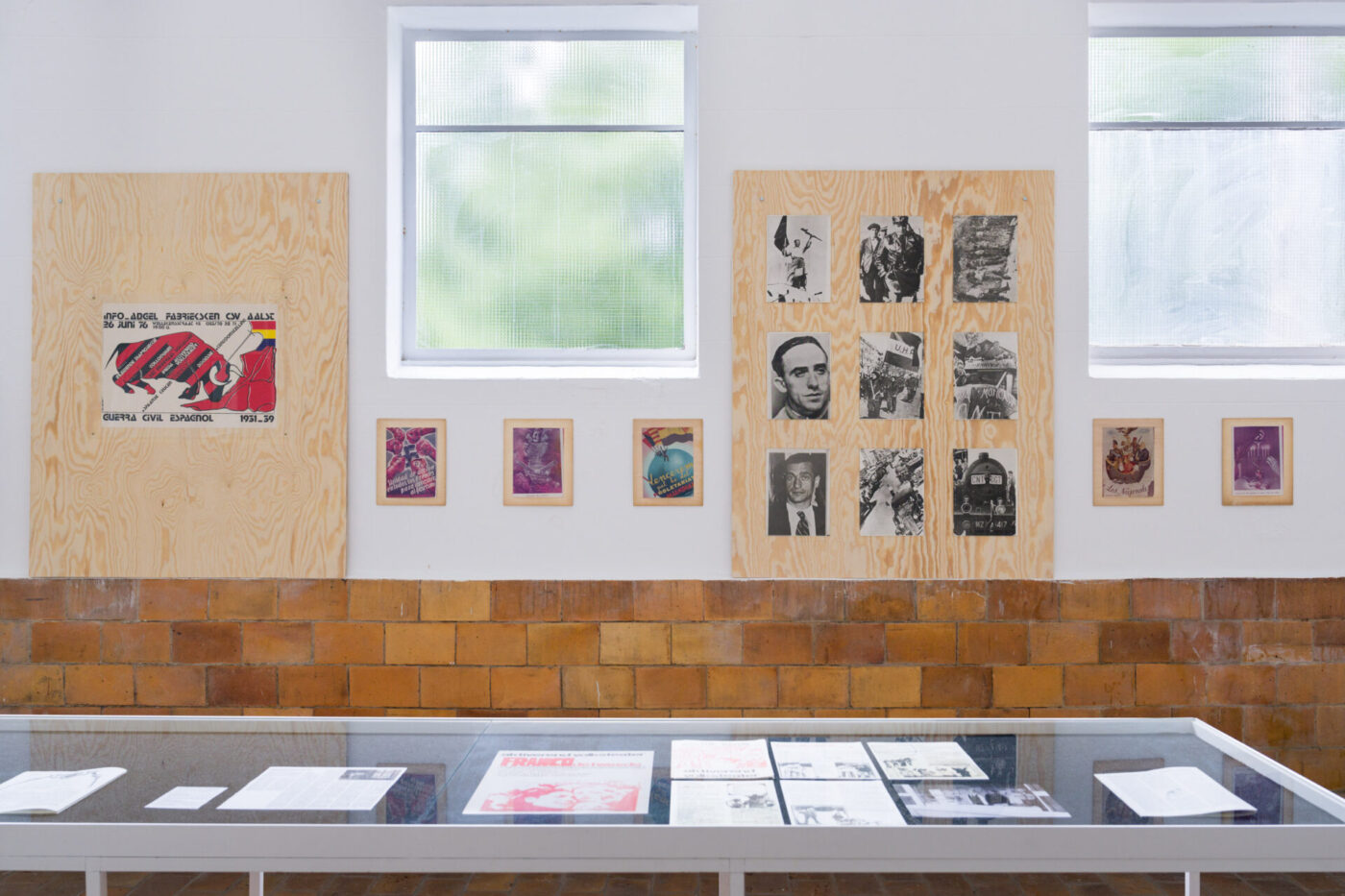


June 1974. The Centre for Societal Renewal (CSV) in Aalst officially opens its doors after a short gestation period. Right from the opening, its intention is clearly defined, as is the mode of operation: it seeks to become familiar with different ideas and living environments, seeing a knowledge of these as the precondition for a society where people live alongside each other in harmony.The center brings together different groups and life perspectives to achieve their goals. One group that is present at the CSV from the beginning, albeit not as an official association, is that of the Spanish expatriates in Aalst. The Spaniards are actively involved in the functioning of the CSV, organizing a Spanish folklore evening during the opening weekend and in the years to follow there will be weekly Spanish meals on offer at the centre.
The fact that the people of Aalst feel a connection with the Spaniards becomes clear in September 1975. Despite international protests, a group of opponents of the dictatorship in Spain is sentenced to death. This sparks a broad wave of protest, and people also take to the streets in Aalst. The CSV organizes various information sessions in the months that follow. On 26 June 1976, the CSV opens the information exhibition ‘Spanje, vroeger en nu’ (Spain, past and present). It’s an ambitious endeavour: in just one evening there is Spanish food, an exhibition, a slide show, a colloquium and a theatre performance with puppets. In consultation with Spanish and Basque witnesses, it highlights the Spanish situation, as well as how the past is seen to seep into current events. What stands out most of all is the great solidarity that the people of Aalst showed with the Spanish refugees. Not only were the refugees warmly welcomed, there was a genuine interest in their stories and a desire to listen to each other beyond merely the superficial details. They were given a place at the CSV and in Aalst.
Full text
June 1974. The Centre for Societal Renewal (CSV) in Aalst officially opens its doors after a short gestation period.1 Right from the opening, its intention is clearly defined, as is the mode of operation: it seeks to become familiar with different ideas and living environments, seeing a knowledge of these as the precondition for a society where people live alongside each other in harmony. The embodiment of this vision is ‘t Utopieken (‘The Little Utopia’), the CSV’s neighbourhood café-bar, kept open daily by another organisation. Here café regulars and the CSV’s visitors come into daily contact with humanists, progressive Catholics, socialists and Marxists, as well as people from Amnesty International, Wereldwinkel, the student organisation, the disabled scouts association and the anti-authoritarian school De Weide. One group that is present at the CSV from the beginning, albeit not as an official association, is that of the Spanish expatriates in Aalst. Some of them arrived in Aalst having fled the civil war, while others were guest workers who in many cases had migrated to Belgium to work in the coal mines. As more and more mines were closed, these guest workers headed out to other towns in search of work. Aalst’s thriving textile industry proved an attractive alternative.2
As a multicultural organisation, the CSV creates space for different groups and different cultures, including their different views. For example, a Spanish folklore evening is set up during the opening weekend and in the years to follow there will be weekly Spanish meals on offer at the centre. A fixture of the kitchen team is Santiago Flores, a member of the militant Spanish Socialist Worker’s Party (Partido Socialista Obrero Español). At this time, Flores, who fled the civil war, is living and working in Aalst as a cook. The people of Aalst are introduced to Spanish culture through Spanish cuisine. The CSV also organises language classes for guest workers. In addition to Spaniards, there are also Moroccan and Italian guest workers who attend these classes.
The fact that the people of Aalst feel a connection with the Spaniards becomes clear in September 1975. Despite international protests, five Basque nationalists and three members of the anti-fascist league are executed in Spain by the regime of General Franco, the Spanish dictator who would die not so long after. In Europe and the rest of the world, there is general indignation surrounding the arbitrary nature of the Spanish military court’s rulings. Wide protest follows, including in Aalst, where people take to the streets. On the initiative of the Belgian Socialist Party (BSP), around 500 demonstrators march through the town centre on 9 October 1975. In addition to the politicians and other sympathisers, the CSV is represented at the march by the Humanist Society and the experimental theatre group PAN.
The name Santiago Flores comes up frequently in this context. Flores makes his voice heard in several opinion pieces in the local media as a critic of Franco and Juan Carlos, who was proclaimed King of Spain after Franco’s death. Besides working in the CSV kitchen, Flores is an active participant in the centre’s meetings and activities. On 17 April 1976, the CSV organises its first information evening on the Spanish Civil War, which discusses the horrors of the war and the Franco regime, but also collectivism in communities and ‘integral socialism’. Flores is the main speaker alongside other participants including the Basque activist Salvador Gurucharri.
A couple of months later, in May 1975, the CSV’s Fabriek Informatiekrant (‘Factory Information Newspaper’) announces that the ‘information project’ that the centre seeks to be has entered troubled waters. The limited number of information projects compromises the Info~Angel’s intention to get to know ‘the other’ through information. However, the anonymous author derives hope from a project that Paul Gees is working on about the Spanish Civil War. Gees, an interior design graduate, was a designer for the progressive Catholic youth magazine Today and got involved at the CSV through a job creation project. Gees took on the interior design of the CSV’s common areas as well as the design of the Fabriek Informatiekrant. In 1976, he collaborates with Santiago Flores, Jan van De Moortel and CSV founder Mon Van Der Biest on a comprehensive and informative exhibition on the Spanish Civil War, coupled with an evening programme on this topic. On 26 June 1976, just before the centre’s annual trip to Southern Europe, the CSV opens the information exhibition ‘Spanje, vroeger en nu’ (Spain, past and present). It’s an ambitious endeavour: in just one evening there is Spanish food, an exhibition, a slide show, a colloquium and a theatre performance with puppets. In consultation with Spanish and Basque witnesses, it highlights the Spanish situation, as well as how the past is seen to seep into current events. The exhibition presents photographs showing Franco’s atrocities and posters of various Spanish resistance movements. The theatre play with puppets and the discussion that followed were arranged by the Dutch experimental theatre group Het Activerend Volkstheater (‘The Activating People’s Theatre’). This company, comprising theatre people, filmmakers and socio-cultural workers, was founded by Monique Bullinga and Bob Entrop. According to their pamphlet, they seek to engage with ‘groups best served by a society in which the people own the means of production, control what is produced and how, and have a say in what happens to the fruits of their labour’. After-show discussions are therefore a regular and essential part of what they do. At the CSV, they present the play Franco de Tweede (‘Franco the Second’). The performance deals with the Spanish Civil War, Franco’s fascism and the role played by King Juan Carlos – ‘Franco the Second’ – following the dictator’s death. The play begins with the social struggles of labourers prior to Franco’s dictatorship, before shifting focus to mass tourism in Spain and the feared future under Juan Carlos. A parallel is drawn between the inequality of 1930s Spain and the exploitation taking place under capitalism, where mass tourism reigns.
The evening is hit-or-miss according to the extensive report by journalist Peter Dauwe in De Voorpost. Dauwe writes that there is a lot of information given through the information panels – too much, in fact. There are also technical problems with the slide show, which only adds to the issue of informational effectiveness. However, the evening ultimately receives a positive evaluation on balance. The piece concludes with the words: ‘No doubt this information evening comes in response to a genuine need. Not only can evenings such as these help more people to get to know their world as it is, insight and knowledge of the true facts is a necessary condition for societal renewal (the ideal behind the CSV). Whether everything has now been said about the Spanish Civil War is debatable. The organisers themselves acknowledge how difficult it was to find proper information on the topic. In any case, an appeal is made to a desire for historical criticism and a love of the truth … Hats off once again to Info-Angel.’
Fifty years later, looking back on this information project spearheaded by Paul Gees, what stands out most of all is the great solidarity that the people of Aalst showed with the Spanish refugees. Not only were the refugees warmly welcomed, there was a genuine interest in their stories and a desire to listen to each other beyond merely the superficial details. They were given a place at the CSV and in Aalst more generally.
Courtesy of: Amsab-ISG (Pascale Welvaert), Bob Entrop, Guido Saey, Marcel Verhelst, Naninga Lens, Paul Gees, Roger and Marie-Héléne D’Hondt Van Audenhove, Stadsarchief Aalst (Lieve Arnouts).
Drawing inspiration from the Info~Angel group and the Centre for Societal Renewal, Info~Angel is a series of exhibitions that illuminate the history of Aalst and the Dender region. What lies concealed in our local past? What stimulates (or ‘stings’) us? And what captures our attention?
15.06.2024-08.09.2024